Publicity

Drink Driving
The campaign against drink driving continues. Over 600 stickers to promote anti-drink driving were placed on parking meters throughout Hong Kong Island, Kowloon and New Territories. Existing anti-drink driving banners placed on flyovers were relocated to deliver the anti-drink driving message to drivers and other road users. Leaflets and souvenirs with the slogan ‘If you drink, don’t drive!’ were distributed, particularly in major entertainment areas, during the festive seasons, especially Christmas and the Lunar New Year, and long holidays. The council has been working on enhancing public awareness of road safety through publicity and education. To remind people not to drive after drinking, the Council continued to adopt the slogan ‘If you drink, don’t drive’to spread the message to all sectors of society.
In order to promote the Road Traffic (Amendment) Ordinance 2010 which introduced measures to combat drink driving, roadside banners and leaflets were produced specifically reminding the public that penalties rise in scale with the severity of the offence – the higher the proportion of alcohol in excess of the prescribed limit, the longer the term of imprisonment and the driving disqualification period. The Council also deployed bus-body advertisements to promote the amended legislation and reinforce the anti-drink driving message and launched weekend publicity events featuring the Road Safety Guard in bar areas throughout the territory.
The number of drivers arrested in traffic accidents involving drink driving dropped by 2% from 214 in 2010 to 210 in 2011. This indicates that drivers are increasingly aware of and responding to our anti-drink driving publicity campaigns and the wider use of breath tests by the Police.
Drug Driving
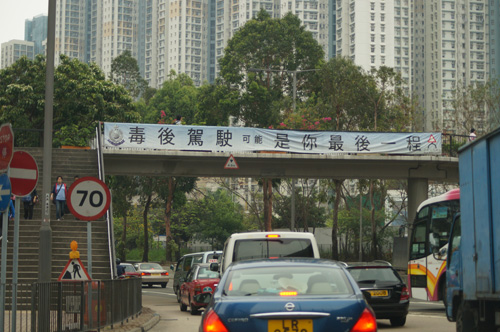
In recent years, the Council has faced a new challenge - an increase in drug driving offences. In order to impose stricter controls over drug driving and provide the Police with necessary powers to enforce drug driving effectively, the Road Traffic (Amendment) Ordinance 2011, which was passed on 14 December 2011 commenced operation on 15 March 2012. To publicise the new legislative amendment on drug driving and to alert drivers the possible effects of drugs on driving, the Council formulated a publicity and education plan to promote anti-drug driving. This included the production of two television and radio announcements of the public interest (APIs) and a range of publicity materials. Additionally, anti-drug driving banners were mounted on flyovers and footbridges above strategic roads with high traffic volumes, telling drivers ‘Drug Driving – May Be Your Journey To Death’ and advertisements were displayed on bus bodies and shelters, and parking meters.
Elderly Pedestrian Safety
Publicity activities throughout the year continued to address the safety of elderly pedestrians. The Council worked closely with District Councils to conduct education and publicity campaigns in areas with relatively more traffic accidents involving elderly pedestrians. Much of this work focused on pedestrian education and, with the assistance of Elderly Road Safety Ambassadors, the elderly were reminded to use proper road crossing facilities, such as traffic light controlled crossings, zebra crossings, pedestrian flyovers and pedestrian subways.

The ‘Road Safety Council in Partnership with the 18 District Councils to Promote Elderly Pedestrian Safety Kick-off Ceremony’ was held in June in the Lecture Hall of the Hong Kong Museum of Art in Tsim Sha Tsui and followed by a bus parade. Celebrities were on hand to appeal to the public to show more concern for the road safety of elderly citizens and to help them cross the road.
In July, in order to bring the issue of elderly pedestrian safety to the attention of the general public, the Council organised the ‘Elderly Pedestrian Safety Photo Competition’. Members of the public were encouraged to participate in the competition and to remind their friends and family members to ‘Love yourself, Love your family, Be a smart pedestrian’. A dedicated website was set up for the competition which attracted an overwhelming response of more than 600 entries. The Road Safety Guard, a figure created by the Council, became a popular icon in anti-drink driving and anti-drug driving publicity campaigns to promote the road safety message.
In November, the ‘Road Safety Council Annual Ceremony 2011 cum Elderly Pedestrian Safety Day’ was held at Citywalk in Tsuen Wan, with the Chairman of the Council, Mr Xavier Tang Kam-moon, Deputy Commissioner of Police (Operations) and other prominent guests and officials officiating. Speaking at the ceremony, Mr Tang said elderly pedestrian safety would remain a focal point of attention for the RSC. He called on the public to make a concerted effort for the vision of ‘Zero accidents on the road, Hong Kong’s goal’.
Safe Cycling
The safety of recreational and functional cyclists continues to be a concern. Pamphlets conveying relevant traffic regulations, responsibilities of cyclists on roads and best practices when using cycling tracks have been widely distributed to cyclists, pedestrians and persons who employ cyclists for rural and urban delivery. A new safe cycling API was launched in television to remind cyclists on the roads of the risks caused by motorists’ blind spots.
In July, the Council and the Tai Po District Council jointly held the ‘2011 Summer Safe Cycling Ceremony’ at Tai Po Waterfront Park. The campaign promoted safe cycling and the importance of wearing a helmet and other protective equipment. About 600 people attended the ceremony and enjoyed a variety of entertainment, including Mr Hung Chung-yam, chairman of the Hong Kong Elite Athletes Association, who shared his experience on the use of cycling safety equipment, and a dance performance by students.
To promote cycling safety, the Transport Department launched an internet-based Cycling Information Centre (CIC) on 21 December 2011 to provide the public with convenient access to information on cycling safety.
To echo the vision of the Road Safety Council in road safety promotion, in 2011, the Transport Department also launched the ‘Safe Driving and Health Campaign’ to enhance safe driving behaviour and health awareness among drivers of commercial vehicles. A wide range of services and activities were provided under the campaign. These included seminars and workshops, radio broadcast of safe driving and health messages, advertisements in newspapers and at tunnel entrances and prominent sites near trunk roads, distribution of posters and stickers and offering free health checks for professional drivers. In addition, newsletters were produced for the various transport trades to enhance awareness and knowledge of safe driving.
The Council strives to deliver road safety messages to the community through various channels and platforms. Over the years, these have included distributing souvenirs bearing the Council’s logo, vision and road safety slogans and adopting innovative ideas to promote road safety activities. In order to bring the issue of elderly pedestrian safety to the attention of the general public, the Council has organised the ‘Elderly Pedestrian Safety Photo Competition’ in July 2011.
Targeted Safety Messages
Broadcasting APIs through different media platforms is an important and effective tool to promote road safety messages to the community. In 2011, four APIs were produced on drug driving, and cyclist and pedestrian safety. In order to promote the enactment of the Road Traffic (Amendment) Ordinance 2011, two television and radio APIs were produced to publicise the new legislative amendment on drug driving, that is, zero tolerance against six specified illicit drugs, namely heroin, cocaine, ketamine, methamphetamine (ice), cannabis and ecstasy, and to alert drivers the possible effects of drug driving. As more and more people take up cycling, an API on cycling safety on the roads was produced and broadcast in the television to remind cyclists of the risks caused by motorists’ blind spots, and aired from early 2012. Another API reminding pedestrians of the importance of proper road crossing discipline was aired on the radio from February.
The Council also explored new channels to broadcast road safety APIs. In addition to radio and television, the APIs were also played in the public areas of six police premises. Other suitable locations will continue to be explored to promote road safety messages.
The Road Safety Council website recorded an average of 3,542 daily visits last year, an increase of 13.5% over 2010. The website, which contains a range of road safety features and provides online access to all Council publications with useful statistics and hyperlinks, aims to effectively disseminate road safety information to the general public.
The Council will continue to explore the use of all media avenues to best reach target audiences with tailored messages.
For further information, please visit:
http://www.roadsafety.gov.hk
http://www.roadsafety.gov.hk/eng/campaign/road_safety_campaigns.html


